
This article is part of the How Do YOU CM2? blog series in collaboration with the Institute for Process Excellence (IpX). Although I receive compensation for writing this series, I stand behind its content. I will continue to create and publish high-quality articles that I can fully endorse. Enjoy this new series, and please share your thoughts!
In this month’s feature article, I explored “The Real Job Description of a Configuration Manager.” But let’s flip the lens and talk about what a Configuration Manager is not.
- A Configuration Manager is not simply a clerk. ➡️ CM is not about pushing paper or processing forms; it’s about ensuring traceability and alignment across every decision that impacts the integrity of the baselines.
- A Configuration Manager is not just a document controller. ➡️ We are not document managers; we don’t own the documents; that is the responsibility of each creator. We empower creators to deliver aligned, accurate outputs fast and efficiently.
- And a Configuration Manager is certainly not just the “process police.” ➡️ The goal isn’t to enforce compliance for compliance’s sake; it’s to create clarity and control so teams can innovate confidently without losing configuration discipline.
Too often, organizations still view CM as an administrative burden rather than a strategic capability that drives product quality, speed, and traceability across the entire lifecycle.
💡 However…
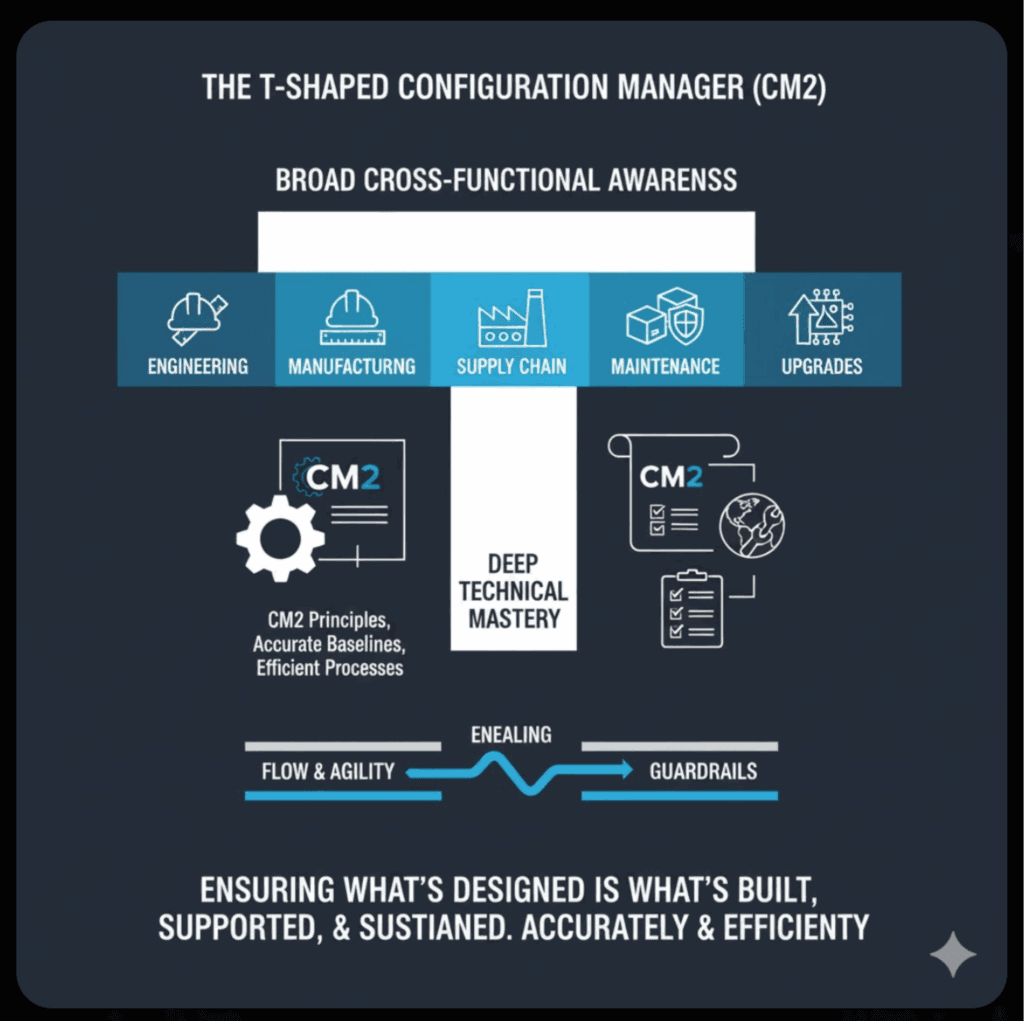
A great Configuration Manager must be T-shaped, combining broad, cross-functional awareness with deep, technical mastery of CM principles. That means understanding how engineering, manufacturing, supply chain, maintenance, and upgrades intersect to safeguard the integrity of all baselines.
When done right, Configuration Management is about enabling flow and agility with guardrails. It’s about ensuring that what’s designed is what’s built, supported, and sustained; accurately and efficiently.
But when CM is reduced to an entry-level support role rather than a leadership function, the organization suffers: baselines drift, cross-functional alignment breaks down, and the organization loses the very control mechanisms needed to scale at speed and with quality.
As industries push toward digital transformation and Model-Based Everything (MBE), the role of the Configuration Manager is evolving fast. We’re not “record keepers.” We’re architects of traceability and the backbone of enterprise agility, connecting all the different functions.
🔄 So I’ll ask you:
How do YOU CM2?
What misconceptions about the Configuration Manager role have you encountered in your organization, and how do you help others see the real value of CM?
Let’s talk about it.👇
Check out the other How Do YOU CM2? posts.
Copyrights by the Institute for Process Excellence.